Auto Battery Size Chart
A clear, printable car battery group size reference for garages, parts counters, fleet managers and DIY owners — BCI group numbers with dimensions in inches and millimetres, terminal layouts, European DIN equivalents and a battery service log, in PDF and editable Excel.
Auto Battery Size Chart Pack
Printable BCI group size chart, terminal and DIN cross-reference guides, a CCA guide, shop poster and an Excel battery log.
- BCI group size chart (PDF, XLSX)
- Terminal & DIN cross-reference (PDF, DOCX)
- CCA & reserve capacity guide (PDF, DOCX)
- Battery replacement log (Excel)
- Shop poster & safety card (PDF)
Formats: PDF, XLSX, DOCX. Instant download after payment (link valid 72 hours, up to 5 downloads). AI-assisted: the templates were drafted with AI help and reviewed and laid out by Kedop.
$7.00 USD, one-time
Secure card checkout by Stripe. Full refund within 7 days — see the refund policy and license.
What the chart pack contains
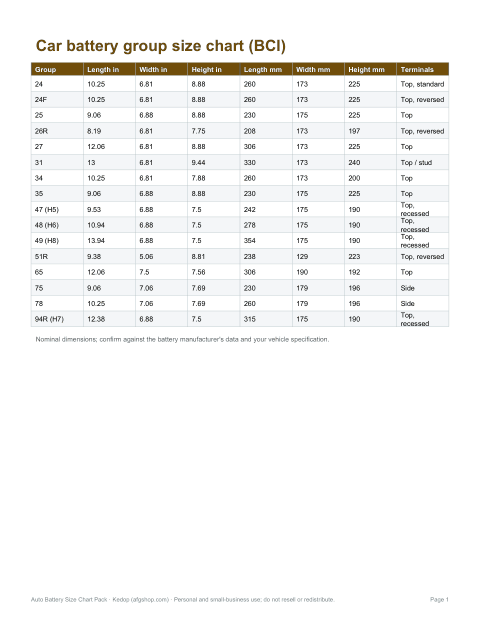
- BCI group size chart — common passenger-car and light-truck group sizes with length, width and height in inches and millimetres.
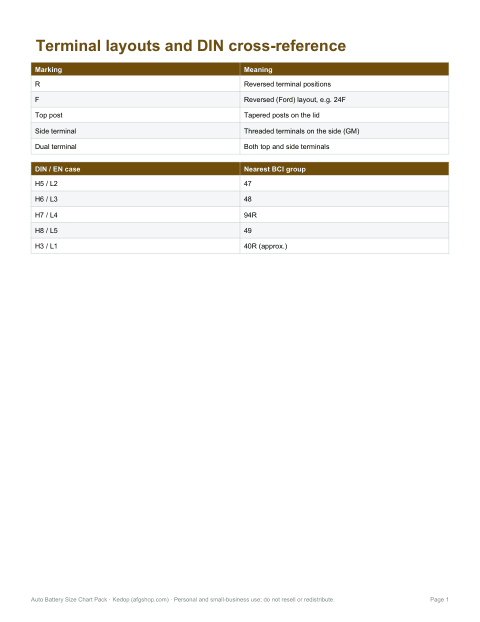
- Terminal layout guide — top-post, side-post and dual-terminal layouts and what the “R” and “F” suffixes mean.
- European DIN / EN size cross-reference — H-series and L-series cases matched to BCI groups 47, 48, 49 and 94R.
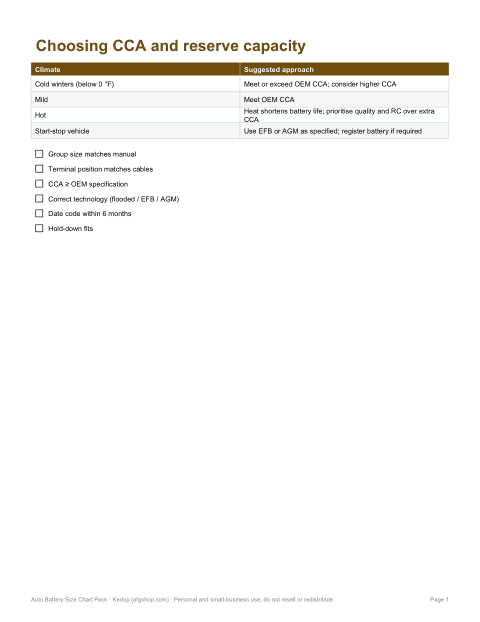
- CCA and reserve capacity guide — how to compare batteries and pick the right rating for your climate.
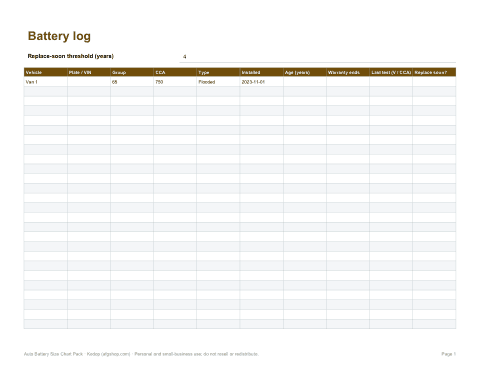
- Battery replacement log (Excel) — track installation date, group size, CCA, warranty and test results for each vehicle.
- Printable shop poster — a one-page quick-reference version for a garage wall.
What a battery group size means
Battery Council International (BCI) assigns group numbers to batteries with standard case dimensions and terminal positions. The group size is about fit: a group 24F battery has the same case as a group 24 but reversed terminals, so the cables reach. It does not describe power — two group 35 batteries can have very different cold cranking amps (CCA). When you replace a battery, match the group size listed in your owner's manual or on the old battery, then choose the CCA and reserve capacity you need.
Sample of the dimensions included
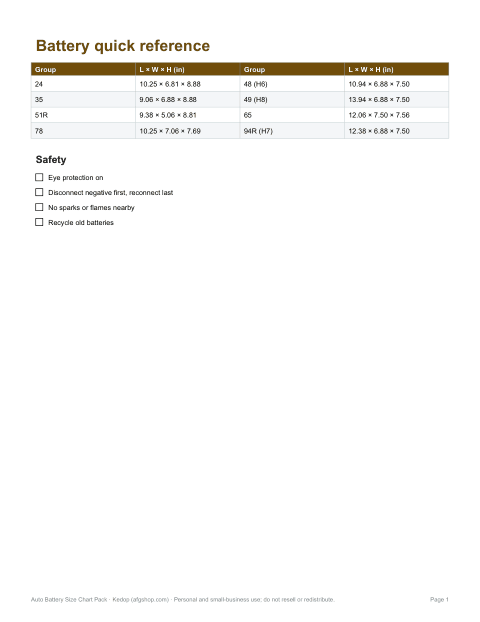
| BCI group | Length × width × height (in) | mm (approx.) | Typical use |
|---|---|---|---|
| 24 / 24F | 10.25 × 6.81 × 8.88 | 260 × 173 × 225 | Many Japanese and US cars; F = reversed terminals |
| 35 | 9.06 × 6.88 × 8.88 | 230 × 175 × 225 | Many Japanese sedans and SUVs |
| 47 (H5 / L2) | 9.53 × 6.88 × 7.50 | 242 × 175 × 190 | Compact European and some US cars |
| 48 (H6 / L3) | 10.94 × 6.88 × 7.50 | 278 × 175 × 190 | Many European and US cars |
| 49 (H8 / L5) | 13.94 × 6.88 × 7.50 | 354 × 175 × 190 | Larger European cars |
| 51R | 9.38 × 5.06 × 8.81 | 238 × 129 × 223 | Small Japanese cars |
| 65 | 12.06 × 7.50 × 7.56 | 306 × 190 × 192 | Ford and other trucks and SUVs |
| 78 | 10.25 × 7.06 × 7.69 | 260 × 179 × 196 | Side-terminal GM vehicles |
| 94R (H7 / L4) | 12.38 × 6.88 × 7.50 | 315 × 175 × 190 | Many European and newer US vehicles |
Reading the rest of a battery label
- CCA (cold cranking amps) — the current the battery can deliver at 0 °F (−18 °C) for 30 seconds while staying above 7.2 volts. Choose at least the CCA your vehicle maker specifies; more helps in cold climates.
- RC (reserve capacity) — minutes the battery can supply 25 amps before dropping to 10.5 volts; useful when the alternator fails.
- Ah (amp-hours) — capacity, common on European labels.
- Type — flooded, EFB (enhanced flooded) or AGM. Vehicles with start-stop systems usually need EFB or AGM, and many need the battery registered with the car's computer after replacement.
- Date code — shows when the battery was made; fresher is better.
Who uses this pack
Independent garages and parts counters use the poster for quick look-ups, fleet managers use the log to plan replacements before winter, and car owners use the chart to check a battery before buying online. The Excel log calculates battery age and flags batteries older than a threshold you choose, a practical warning because many batteries fail after around three to five years depending on climate and use.
Formats
The chart and poster are print-ready PDFs (US Letter, also printable on A4), the log and chart data are editable XLSX workbooks, and the guides come as Word documents you can adapt with your shop's name. The pack is a reference; it does not replace the vehicle manufacturer's specification.
Safety reminders included
Car batteries contain sulphuric acid and can release explosive hydrogen gas. The pack includes a safety card with the key rules: wear eye protection, remove jewellery, disconnect the negative terminal first and reconnect it last, keep sparks and flames away, and recycle old batteries at a parts store or recycling centre — lead-acid batteries are among the most recycled consumer products and should never go in household waste.
Frequently asked questions
Is a bigger CCA battery better?
It will not hurt as long as the group size fits; the car only draws what it needs. It mainly helps starting in cold weather.
What does the R in 51R mean?
R indicates reversed terminal positions compared with the standard layout for that group.
Are DIN sizes the same as BCI groups?
Several are close equivalents, such as H6/L3 and group 48. The chart lists common matches; check exact dimensions and terminals.
Can I edit the chart?
Yes, the Excel and Word versions are fully editable. The PDF is for printing.
Was this made with AI?
The layouts and text were drafted with AI assistance, then checked, edited and formatted by Kedop. Dimensions should still be confirmed against the battery maker's data.